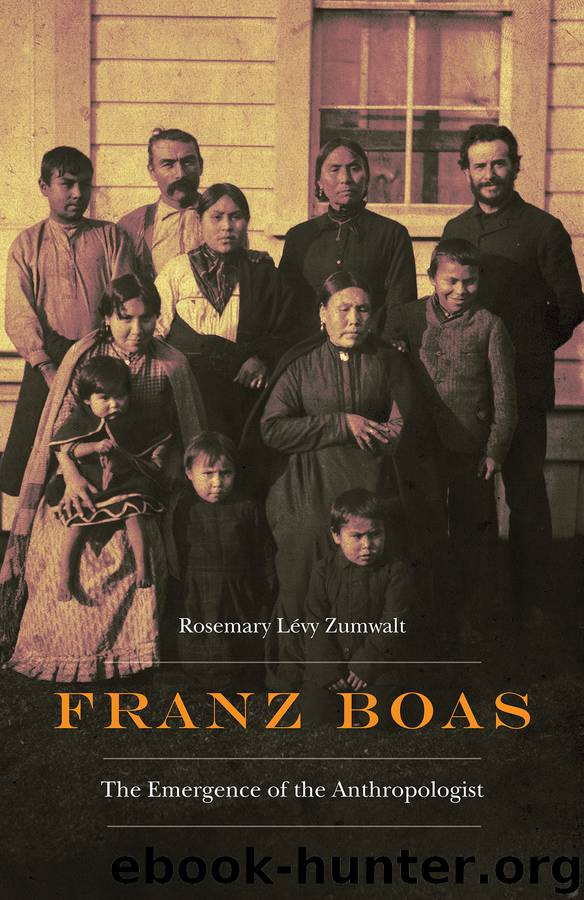
Franz Boas: The Emergence of the Anthropologist by Rosemary Lévy Zumwalt
Author:Rosemary Lévy Zumwalt
Language: eng
Format: epub
Tags: Cultural & Social, BIO006000 Biography & Autobiography / Historical, BIO019000 Biography & Autobiography / Educators, Biography & Autobiography, General, Social Science, Historical, Educators, Anthropology, Sociology, SOC002010 Social Science / Anthropology / Cultural
Publisher: U of Nebraska Press
Published: 2019-11-02T00:00:00+00:00
Warren P. Lombard went to the University of Michigan as a professor of physiology. Only Boas was left without an academic position. Possibly Harper decided not to offer Boas a position because, as Browman and Williams suggest, “Boas lacked any national visibility” in 1892. Or perhaps Harper left the decision as to whether or not to hire Boas to Albion W. Small, who was head professor of social science and dean of the college of liberal arts. With respect to the latter point, Harper had given responsibility to the heads of departments to identify potential faculty and then to consult with the president. Albion Small headed the department of two, joined as he was by Frederick Starr, assistant professor of anthropology. As the first professor of sociology in the United States, Professor Small would not have relished being outnumbered by two anthropologists and thus was likely in hearty agreement with Harper’s decision not to hire Boas. Finally, there was the possibility that Harper simply did not warm to Boas when he met him in Worcester. Goodspeed remarked that Harper followed an intensive process for identifying potential faculty, but, ultimately, he relied on his own judgment when he met with the potential faculty in person. In sum, there is simply no definitive answer as to why Harper did not hire Boas.33
Boas and Marie had passed a full life as a family during their three years in Worcester. In February 1891 “‘the shrieking Ernst’” had been born. Boas joked in his letter to his parents that his son was the reincarnation of the Raven in the folk narratives that he had collected in British Columbia. The following year, in February 1892, Boas had become a naturalized United States citizen. Boas and Marie had made enduring friends with the Baurs, the Donaldsons, and with Oskar Bolza. Marie wrote to her in-laws about “the custom in the small towns” to have new comers over for dinner. “We really have more company with us here than in New York. It is easier to get people together and it’s all simple here.” With the gift of money from Franz’s parents, they rented a piano: “We really are spoiled children. . . . Franz plays every day now.” Marie wrote of the friends who gathered to play “something from Mozart” and other selections, “On Sunday Prof. Michelson, a physicist, played the violin; and Herr Loeb, the viola; and Franz the piano. . . . I am so happy for Franz that he now and then has some music.” In June 1892 Boas and Marie, with their little girl, Helene, who would be four years old in September, and baby Ernst, at sixteen months, departed Worcester for Germany.34
Boas would return to Worcester in September 1909 from his position as professor of anthropology at Columbia University for the twentieth-anniversary celebration of the founding of Clark University. Professor of Psychology E. C. Sanford had extended the invitation to Boas: “It would give us all the greatest pleasure if you would consent to be present and to give one of these lectures in the psychological program.
Download
This site does not store any files on its server. We only index and link to content provided by other sites. Please contact the content providers to delete copyright contents if any and email us, we'll remove relevant links or contents immediately.
| Africa | Asia |
| Canadian | Europe |
| Holocaust | Latin America |
| Middle East | United States |
Fanny Burney by Claire Harman(26677)
Empire of the Sikhs by Patwant Singh(23150)
Out of India by Michael Foss(16992)
Leonardo da Vinci by Walter Isaacson(13429)
Small Great Things by Jodi Picoult(7265)
The Six Wives Of Henry VIII (WOMEN IN HISTORY) by Fraser Antonia(5571)
The Wind in My Hair by Masih Alinejad(5155)
A Higher Loyalty: Truth, Lies, and Leadership by James Comey(5031)
The Crown by Robert Lacey(4880)
The Lonely City by Olivia Laing(4872)
Millionaire: The Philanderer, Gambler, and Duelist Who Invented Modern Finance by Janet Gleeson(4553)
The Iron Duke by The Iron Duke(4421)
Papillon (English) by Henri Charrière(4338)
Sticky Fingers by Joe Hagan(4269)
Joan of Arc by Mary Gordon(4172)
Alive: The Story of the Andes Survivors by Piers Paul Read(4098)
Stalin by Stephen Kotkin(4025)
Aleister Crowley: The Biography by Tobias Churton(3680)
Ants Among Elephants by Sujatha Gidla(3503)
